
Blog
We are committed to providing customers with high-quality and low-price steel products as its goal, and strives to create value for customers as its own responsibility.
Introduction
When selecting stainless steel for industrial and construction projects, two of the most widely used grades are 304 and 316. Although they look similar, their chemical composition and corrosion resistance are different, which directly affects performance in various environments.
Understanding the difference between 304 and 316 stainless steel helps engineers, contractors and buyers choose the right material for durability, safety and cost efficiency, especially in marine, coastal and chemical applications.
Difference Between 304 and 316 Stainless Steel
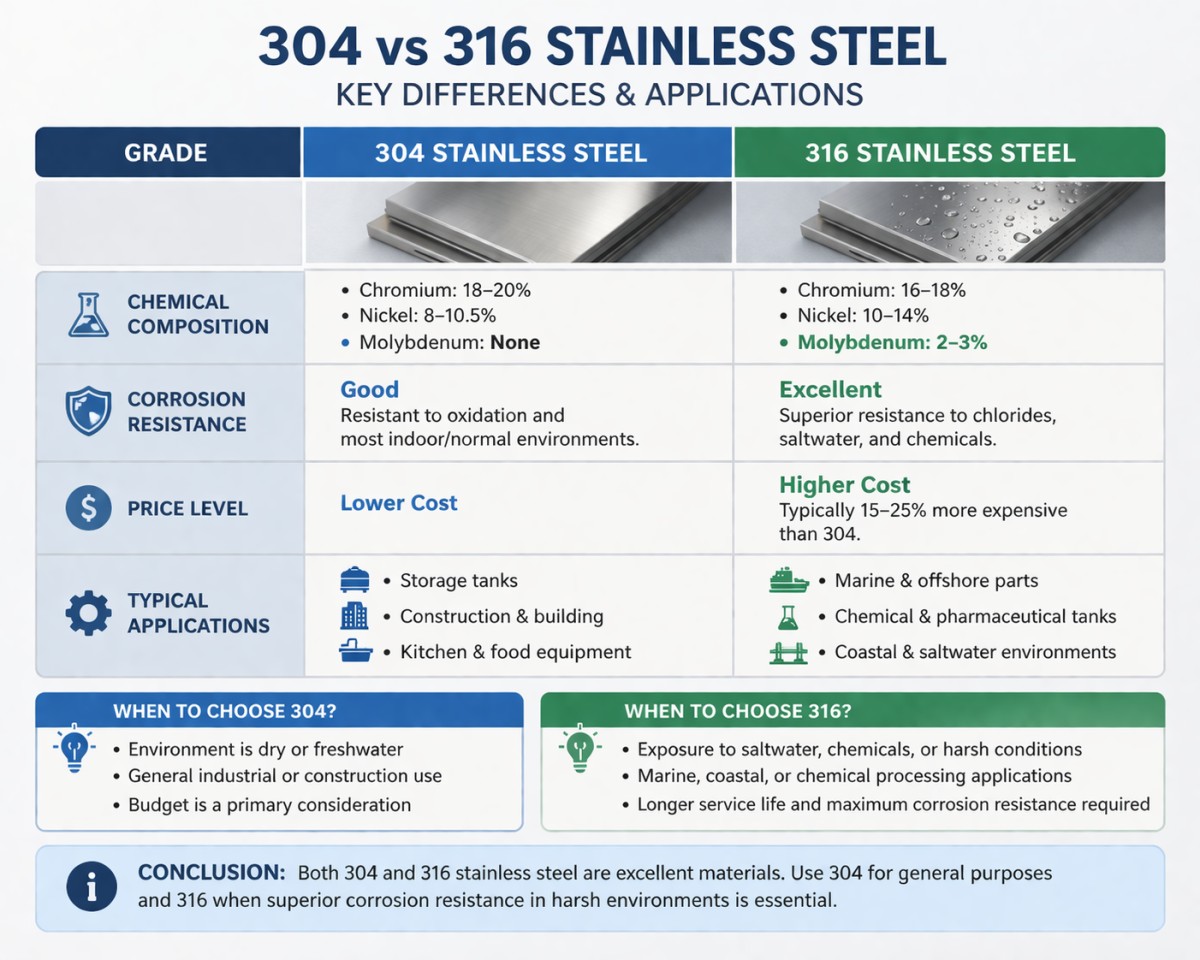
The key difference is the addition of molybdenum in 316 stainless steel.
Molybdenum greatly improves resistance to chlorides, saltwater, and chemical corrosion.
Corrosion Resistance
- 304 stainless steel provides excellent corrosion resistance for general environments, indoor use, and fresh water exposure.
- 316 stainless steel performs much better in marine, coastal, and chemical environments due to molybdenum content.
If your project involves saltwater, humidity, or chemicals, 316 is the safer and longer-lasting option.Typical Applications
304 Stainless Steel
- Storage tanks
- Building structures
- Kitchen equipment
- Food processing equipment
- Decorative applications
Typical Applications
316 Stainless Steel
- Marine components
- Chemical tanks and pipelines
- Coastal construction projects
- Pharmaceutical equipment
- Heat exchangers
Price Difference
316 stainless steel is typically 15–25% more expensive than 304 due to added alloying elements. However, in corrosive environments, the longer lifespan offsets the initial cost.
Maxwell Steel is a professional steel plates, sheets and coils supplier from China.


GET A QUOTE