
Blog
We are committed to providing customers with high-quality and low-price steel products as its goal, and strives to create value for customers as its own responsibility.
Be careful when selecting materials for coastal construction projects - Is 304 stainless steel plate for construction really more corrosion-resistant than 201?
How does a chloride ion environment really corrode stainless steel plates? The measured failure time difference is up to 3 times
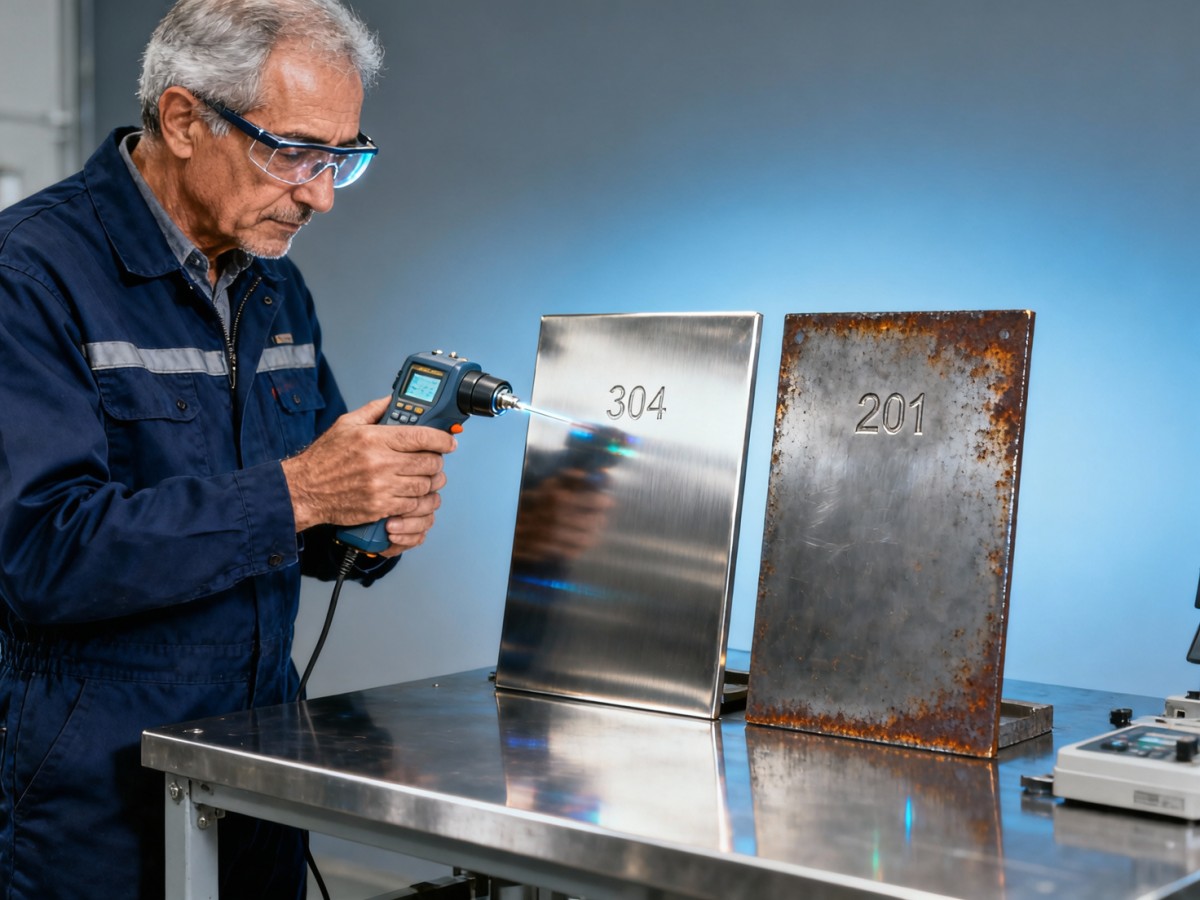
In a coastal super high-rise curtain wall project in Lianyungang, we conducted a continuous neutral salt spray test (ASTM B117) on 304 and 201 stainless steel flat plates (thickness 4mm, surface 2B) of the same specification to simulate typical working conditions where the annual average chloride ion deposition is >150 mg/m²·d. The results showed that visible pitting corrosion pits (diameter ≥ 0.15mm) appeared on the 201 plate at 96 hours, while the stable pitting corrosion core was not detected for the first time until 288 hours on the 304 plate.
Further combined with the three-year actual measurement data of Pingtan Island in Fujian, it was found that the 201 structural parts exposed in the area less than 500m from the coastline need to be partially replaced after an average of 18 months of service; while the 304 components under the same conditions did not show any puncture failure within 36 months, and only a slight yellowing oxide film appeared on the surface. This difference is due to the synergistic passivation mechanism of nickel (Ni) and chromium (Cr) - 304 contains 8-10.5% Ni and 18-20% Cr, while 201 only contains 3.5-5.5% Ni and 16-18% Cr, and its resistance to chloride ion penetration is significantly limited.
It is worth noting that 201 is more prone to intergranular corrosion in the welding heat affected zone (HAZ). The laboratory used the DL-EPR electrochemical testing method to measure that the critical pitting temperature (CPT) of the weld zone of 201 is 38°C, while that of 304 reaches 72°C. This means that in the high-humidity and high-salt environment in summer, the 201 weld may enter the pitting corrosion acceleration period in advance.
Comparison of key performance parameters (based on GB/T 20878–2007 and ASTM A240)
PREN (pitting equivalent number) is the core parameter for evaluating the pitting corrosion resistance of stainless steel. The calculation formula is: PREN = %Cr + 3.3×%Mo + 16×%N. Due to its higher Ni and Cr content, 304 forms a denser passivation film in a chlorine-containing environment. Its PREN value is about 23% higher than that of 201, which is directly reflected in the actual service life.
The 3 types of risk scenarios that are most easily ignored
Not all “coastal projects” apply the same material selection logic. In the following three types of scenarios, the 201 failure probability exceeds the normal value by more than 3 times:
- The contact area between the curtain wall keel and the direct sea breeze blowing surface (wind speed > 8m/s and daily average humidity > 85%)
- Thin-walled special-shaped structures such as roof ventilation louvers and awning supports (plate thickness ≤3mm and dense welding areas)
- Offshore industrial plants contain salt spray + acidic condensation water composite environment (pH <5.6 and Cl⁻ concentration >200ppm)
Special reminder: Some dealers label 201 as an "economical 304 substitute", but GB/T 20878 clearly classifies 201 as a "nickel-saving austenitic stainless steel", and its corrosion resistance mechanism is essentially different from that of 304. Before delivery, be sure to check the actual measured values of chemical composition in the steel factory's warranty to avoid a sudden drop in local corrosion resistance caused by an imbalance in the Mn/Ni ratio.
Why choose Maxwell Steel?
As a manufacturer specializing in the export of stainless steel and carbon steel profiles, Maxwell Steel (Jiangsu) can provide you with customized guarantees for coastal projects:
- For 304/201 plates, supporting stainless steel H-shaped steel, angle steel, channel steel and flat steel are simultaneously supplied to ensure that the entire set of structural parts has uniform materials and meets the welding matching standards.
- Supports EN 10088-2, JIS G4304, GB/T 4237 and other multi-standard certification documents delivered with the goods
The delivery cycle for regular orders is stable at 15-20 working days, and the green channel can be activated for urgent orders (the fastest can be shipped out of the factory in 7 working days)


GET A QUOTE